Braces for Kids: A Parent's Complete Guide
September 10th, 2026
Written by Blake Hickey | Clinically reviewed by Dr. Marissa Cooper, DMD, MS | Last reviewed September 25, 2026
The Short Answer
Braces for kids are easier to plan for when you know what to expect. At Orthodontics of Weston, Dr. Marissa Cooper typically sees children with braces about every eight weeks. Her team helps families understand their insurance benefits and stays in touch with their child’s dentist. This guide answers common questions about appointments, care at home, and retainers, from the first consultation to the day your child receives a retainer.

What Questions Should Parents Ask Before Treatment Starts?
Before recommending anything, Dr. Cooper lays out the plan step by step, from start to finish, and she welcomes the questions parents bring with them. It is an approach she learned early, from her father, orthodontist Dr. Marc H. Cooper, who mentored her from a young age.
“The best part is that there are no surprises because you have a clear plan and can explain to your child what will happen during today’s visit and what to expect at the next one.”
Dr. Marissa Cooper, DMD, MS

It also helps to write your own questions down beforehand, so nothing is forgotten once you are in the room. According to the American Association of Orthodontists, a first orthodontic exam generally addresses [1]:
- Whether there is an orthodontic problem, and if so, what it is
- The treatment options that are available
- How long the recommended treatment is expected to take
- How much the recommended treatment will cost
Those four make a good starting point for the conversation. If you are still deciding whether your child needs an evaluation at all, our guide on when a child should see an orthodontist is a good place to begin.
Does Insurance Cover Braces?
It depends on the plan, and the details are easy to mix up. Dr. Cooper points out that medical insurance, dental insurance and orthodontic coverage are three different things, and that a family can have dental coverage without an orthodontic benefit at all.
A few things are worth knowing before treatment begins. If your employer offers a choice of plans during open enrollment, comparing any difference in premium with the orthodontic benefit can show whether the upgrade makes sense for your family. Orthodontic coverage is also typically a lifetime benefit, so it is worth understanding how yours works ahead of time. And when you come in, it helps to have the insurance information for whichever parent holds the plan.
The team can review your benefits with you at that first visit and takes care of the paperwork, so there is less for you to manage.

How Often Will We Be at the Orthodontist?
Less often than most parents expect. Dr. Cooper typically sees children with braces about every eight weeks, or roughly six times a year, and a couple of those visits can often be scheduled over the summer. For many families, that works out to about one missed class or after-school activity a semester.
The office also works around the school calendar. Routine visits are scheduled after school hours when possible, and the office is open on most school holidays, other than Christmas and Thanksgiving, as well as many half days. For a first consultation, 4 p.m. appointments are available for families who would rather not miss school at all. The longer appointments, which are mostly putting braces on and taking them off, are usually scheduled during the day, when children have the energy and attention a longer visit asks of them.
"We know that they're busy. We know parents are busy, and we know that extracurriculars, honestly, are sometimes even more important than the school day. Don't tell the teachers."
Dr. Marissa Cooper, DMD, MS
For schools that ask for documentation, the office provides a printout of the planned appointment beforehand and a note confirming attendance afterward.
How Does the Orthodontist Work With Our Family Dentist?
Most families can keep the dentist they already have. Dr. Cooper notes that most pediatric and general dentists in the area have trained their hygienists to clean teeth with braces and aligners.
"I have full confidence that you could keep your dental provider if you're happy with them."
Dr. Marissa Cooper, DMD, MS
The two offices work alongside each other throughout treatment. With your permission, the team contacts your child's dentist before braces go on to make sure the teeth and gums are healthy first. During treatment, Dr. Cooper typically suggests one extra cleaning a year. Her reason is clinical rather than cosmetic: the body has to fight infection before it can move teeth, so healthy gums help treatment move efficiently. The full explanation is in our guide to braces for teens. Your child keeps a familiar dentist, and the two offices stay in touch.

How Can Parents Help With Brushing at Home?
Brushing with braces is not complicated, but it does ask for consistency. When parents ask about special tools, Dr. Cooper's answer is refreshingly simple: the most important one is still a toothbrush. As she puts it, braces take "a little extra time, a little extra oversight, a little extra effort." She is also candid that helping children brush well can be a challenge through the teenage years, with or without braces.
A few habits make the parent's part easier:
- Ask for feedback at each visit. The team reviews brushing at every appointment and tells both the parent and the child where a little more attention is needed.
- Watch the practice's how-to videos together. They make a useful refresher for the whole family, not just the child in braces.
- Make the evening routine the thorough one, so that school mornings can stay calm.
More tips for daily care are on the life with braces page.
What Should Go in a School Lunch?
Lunch is one of the few meals parents do not see, so it helps to plan a little. Dr. Cooper asks families to avoid hard and sticky foods, and her favorite reminder for children is that teeth are not tools.
Lunch box choices that fit those guidelines include:
- Soft sandwiches, wraps or pasta
- Soft cheeses, yogurt and smoothies
- Bananas, berries and other soft fruit
- Soup or mac and cheese in a thermos
- Meat cut into small, bite-sized pieces
Hard candy, sticky candy, gum and popcorn are best left out of the lunch box and the snack bag. If someone else handles snacks after school, such as a grandparent, a coach or an after-school program, it can help to share that list with them, too.
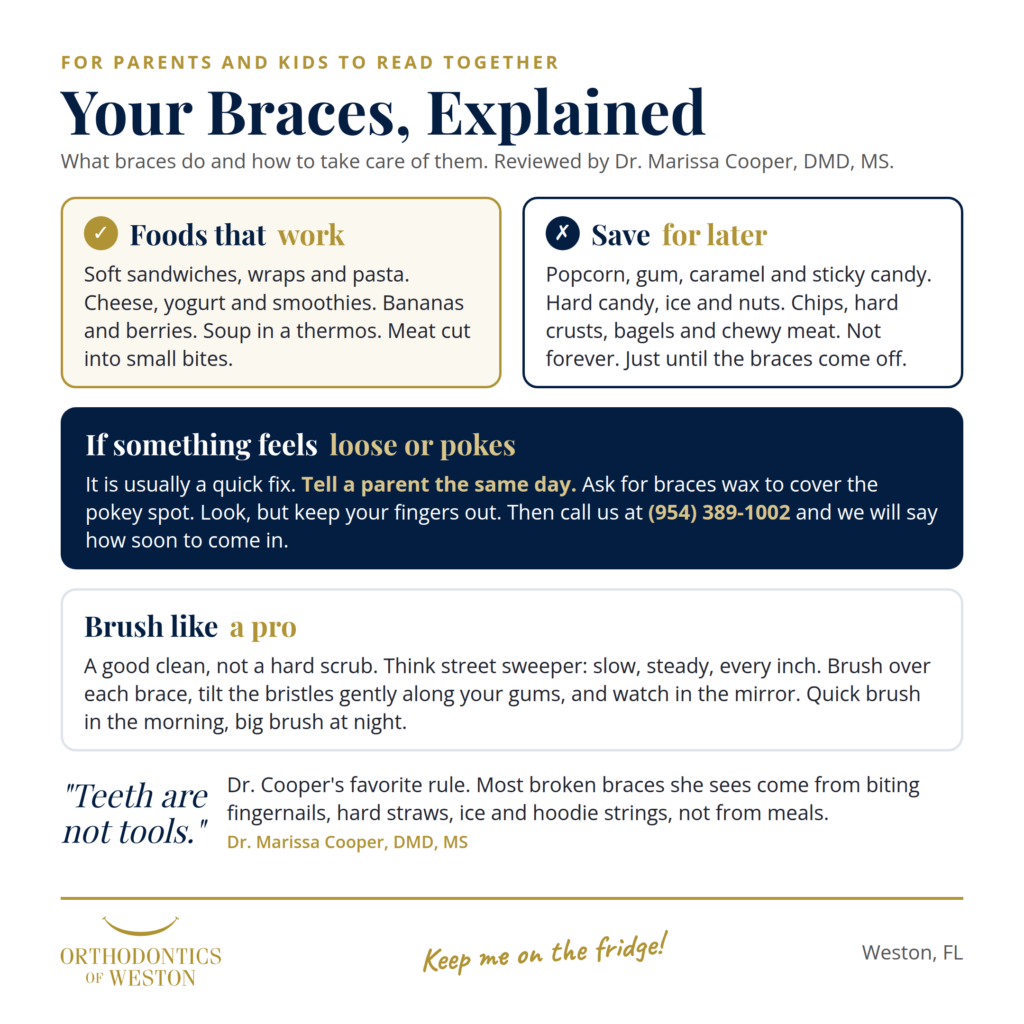
We also put the essentials on a single page, written for parents and kids to read together. It covers which foods work and which can wait, how to brush around a brace and what to do if something feels loose, in plain language a child can follow. Save the image or print it, read it through once and keep it on the fridge.
What Should Parents Do If Something Breaks?
One of the most helpful things a parent can do is make it easy for a child to speak up. In Dr. Cooper's experience, a repair made within about a week usually does not cost any time. The delays come later, when a loose bracket or a bent wire goes unmentioned, to parents or to the office, for weeks at a time.
Children who know it is perfectly fine to say that something feels loose tend to mention it right away, which keeps a small repair from becoming a setback. If something does break, call the office. Our braces for teens guide covers what to do at home in the meantime.
What Should Parents Know About Retainers?
Wearing a retainer is part of treatment, and it begins the day the braces come off. Before that day arrives, two questions are worth asking: what the wear schedule is for each retainer, and what to do if one is lost or broken. The answers are usually short, and knowing them ahead of time makes the transition out of braces much easier.
Most of the parent's part comes down to steady routines and staying in touch with the office. Neither takes much time, and both make the months in braces easier for everyone.

Frequently Asked Questions
How often are braces adjusted?
Typically about every eight weeks, or roughly six times a year. The longer visits, such as the day braces go on, are usually scheduled during the day, and shorter routine visits are often scheduled after school.
Can the first consultation be scheduled after school?
Yes. Consultations at 4 p.m. are available for families who would rather not miss school, and the office is open on many half days and most school holidays.
Where can we find braces for kids near Weston, Florida?
Orthodontics of Weston is located at 1600 Town Center Blvd, Suite A, in Weston, Florida. Families from Weston and nearby Broward County communities, including Cooper City, Davie, Pembroke Pines, Plantation, Southwest Ranches and Sunrise, can request an appointment online or by phone.

Schedule a Braces Consultation in Weston, Florida
If your child has been told they may need braces, or you are wondering whether now is the right time, a consultation with Dr. Cooper is a good place to get your questions answered. Families across Weston and Broward County see her for braces for kids, teens and adults.
Orthodontics of Weston offers consultation times designed to work with school and family schedules, including select after-school, late-afternoon, half-day and school-holiday availability.
Request an appointment online or call (954) 389-1002.
Orthodontics of Weston proudly serves children, teens and families throughout Weston and Broward County.

Written by Blake Hickey
Blake manages marketing for Orthodontics of Weston. He has been a patient at different practices across the country over the years, going through expanders and braces as a kid, along with jaw surgery, aligners and retainers in his 30s. Because he is not an orthodontist, he sits down with Dr. Cooper to ask the questions he once had and that real patients ask today, then writes up what he learns to make treatment easier for families to understand.

Clinical review by Dr. Marissa Cooper, DMD, MS
Dr. Marissa Cooper is the owner and orthodontist at Orthodontics of Weston. She joined the practice in 2013 and is now its owner, and the practice has served South Florida families since 1989. She earned her Doctor of Dental Medicine from the University of Florida College of Dentistry and completed her orthodontic certificate and Master of Science at Nova Southeastern University. She is a member of the American Association of Orthodontists.
Learn more about Dr. Marissa Cooper
This article is for informational purposes only and does not constitute medical advice or a doctor-patient relationship. Schedule an evaluation with a licensed orthodontist for individual care.